| |
Line-arrays, although not new, seem to be the latest
“flavour of the month” in sound reinforcement. And
indeed, a line-array can offer significant advantages in
throw and control, when designed correctly. The biggest advantage of a (well designed) line-array
is the efficiency and relative simplicity of the sound
system, in providing SPL and coverage control over a
defined area.
For a line-array (basically “an array of line sources”),
a true cylindrical wave front is the (only) key to a good
working line-array system and many attempts are being
made to create this type of wave front with traditional
compression drivers.
The main criteria for getting a well designed array, is
to get all drivers working together, instead of working
against each other. Since each frequency has a
different wave-length, the secret to “summing” is that
the sources/speakers must be closely coupled, with a
distance less than half a wavelength of the highest frequency
they have to reproduce.
For low frequencies this is no problem, where the size
of the speaker is well within “half of the wavelength”.
The real challenge is in mid and high frequencies; Here
the physical size of the speaker is too big for its wavelength,
resulting in individual point sources instead of a
seamless cylindrical wavefront.
If we calculate half of the wavelength with the formula
“Wavelength = Speed of sound divided by Frequency”,
we can see that for correct summing, a frequency
of 20.000 Hz, should be reproduced by a transducer
not bigger than 8,6mm.. Knowing that (one of) the
smallest HF speakers measures 24mm (so effective up
to 4,1kHz), it is clear that this is not possible. Taking
half the frequency (10kHz.), the required speaker size
is still only 17,2mm. And we didn’t even mention usable
SPL with a speaker this size…!

|
|

no coherent waveform possible
The only possibility of getting correct summing at these
frequencies, is to generate/simulate an cylindrical/
Isophase wavefront.
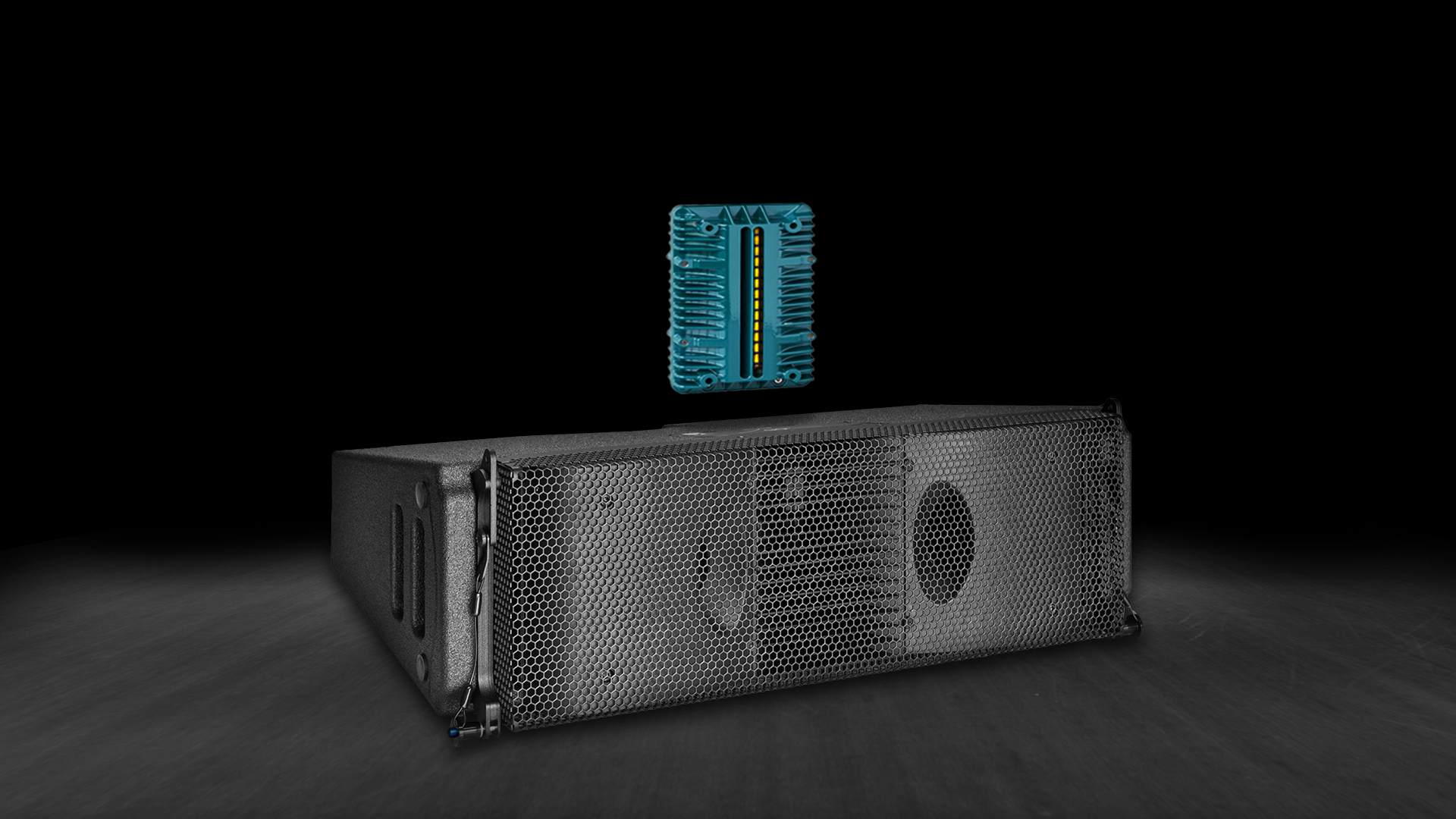
One can thus try to transform a point source (dome
tweeter, compression driver) into an isophase/cylindrical
wavefront (as done by every manufacturer in more
or less successful way), but this will be done at the expense
of substantially decrease of sound quality;
The waveguides necessary for this, introduce a further
increased distortion as result of reflection and compression,
as induced by the channelled sound waves.
In combination with a generally used compression
driver (that isn’t exactly known for its uncoloured, distortion-
free high transient response to begin with…) this
leads to a very bad “signal-to-noise” (S/N) ratio.
Taking the above-mentioned negative side-effects into
account, one would ideally like to start with an “instant”
isophase wavefront, instead of going through this “creative
plumbing” ……
|