|
Alcons' ribbon drivers were developed by Philip de Haan, sr. R&D
engineer and 20+ year veteran in ribbon transducer technology. He
is initiator of a number of significant patents and can be seen
as "father" of today's high-output pro-ribbon technology.
De Haan: "Since 1983 we've been expanding the learning curve
and did a lot of research on new materials, techniques and production
processes. We've tested every medium-to-large sized ribbon driver
on the market, to see and measure for ourselves what the current
status of ribbon development is. Now this know-how has led to a
new generation of ribbon drivers with the RBN601 being the first
result of that."
Over the last years, the ribbon has gained popularity in the pro-audio
market, because of the
fast transient response and the accurate sound reproduction, required
by today's new high-resolution media, like SA CD a.o.. The low weight
moving mass of the diaphragm results in a transient response which
delivers exceptional clarity, intelligibility and throw. Ribbon
drivers feature extreme low distortion, only 1/10th of the THD of
existing (compression or dome) drivers. Because of the different
working principle, a ribbon driver does not have a "compression
threshold", maintaining the same tonal balance at all sound
pressure levels. The flat-response caters for increased "gain-before-feedback"
even in the most critical circumstances.
The
RBN-series pro-ribbon drivers are the only ribbon transducers delivering
real 90° horizontal coverage (patented). The wide dispersion,
combined with the natural cylindrical wave pattern, makes them ideal
for line-array applications.
The RBN1801 is the latest development in Alcons pro-ribbon technology.
With the on-going research on array-technology, the need existed
for a larger, single-diaphragm driver: Of course, a larger radiating
surface can be made with multiple smaller drivers, but this will
drastically sacrifice the degree of frontal-radiation, which is
one of the main criteria for line-source behavior.
The
effective radiation length of 18" / 46cm. offers an extreme
power handling of 210W RMS and 3kW peak (for 200ms, which is ten
times the industry standard) and a very high efficiency of 108dB
with 1Watt @ 1m. With a 90-degree wave-guide, this efficiency even
rises to 110dB, with a frequency operating range of 1kHz. - 20kHz.(+/-3dB)
and a maximum SPL of 145dB.
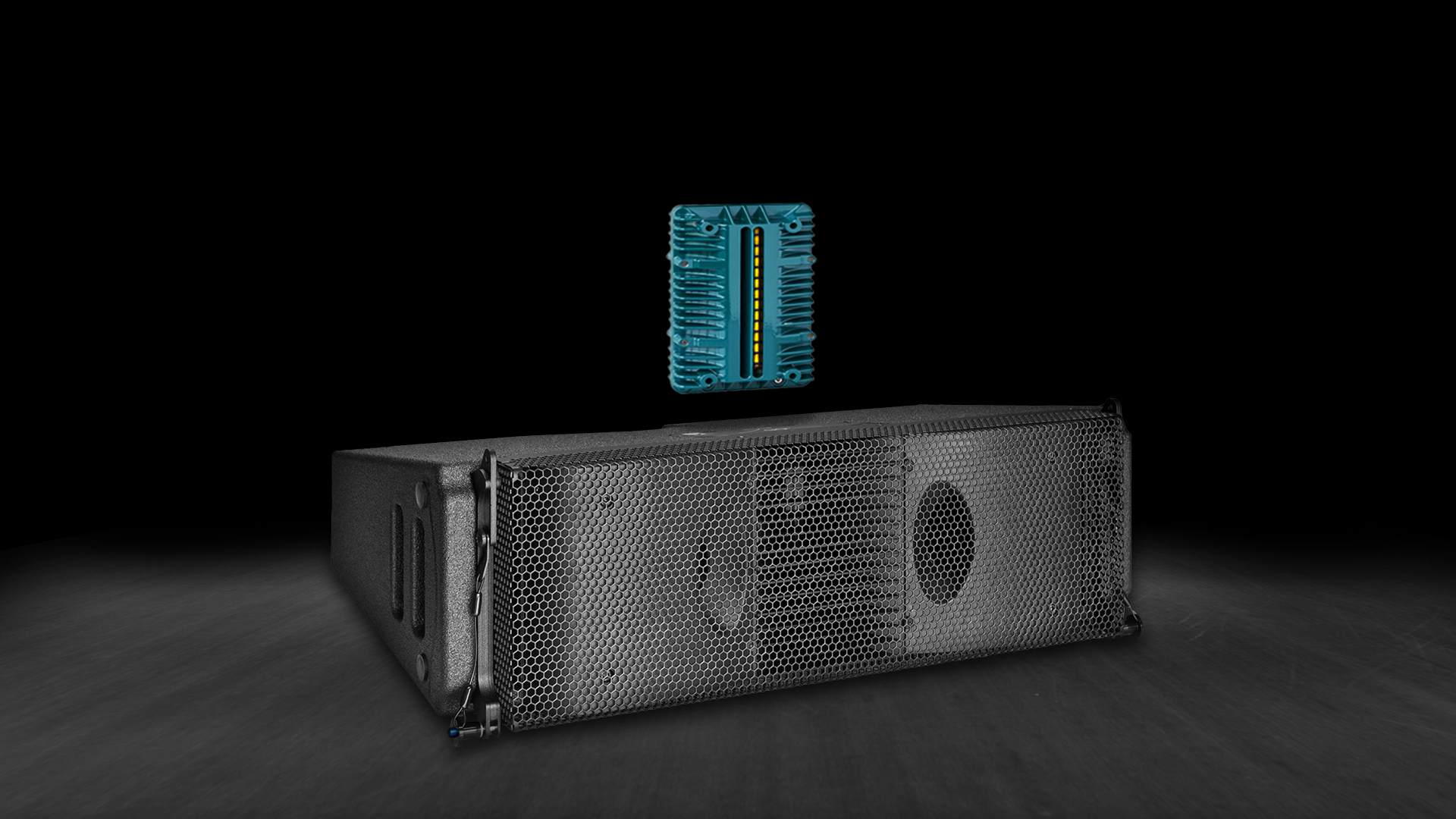
The RBN601 has a true power handling of 70W/1000W, enabled by the
proprietary designed heat-management (patent pending) and an unsurpassed
efficiency of 103dB (log average 2-10kHz 1W/1m), making it the most
powerful ribbon driver unit in its category. With its "Alcons
green" color scheme, the driver has therefore been nicknamed
"the Hulk" ;-)
The RBN401 is a scaled-down version of the RBN601. With a power
handling of 50W/800W and an efficiency of 100dB (log average 2-10
kHz.) it's "the Hulk"s smaller brother, therefore named
"baby Hulk".
Philip de Haan: "During the market research we found that
not only the technology but also accuracy of the production process
is critical with this type of technology. True craftsmanship and
experience are essential for production stability with this type
of transducer technology."
Ribbon tweeters have traditionally been characterized as fragile,
with low power handling, low efficiency and low impedance. With
the low weight moving mass, the ribbon offers considerable advantages
in response especially at frequencies of above 8kHz. In this "fidelity-area"
of the sound spectrum, the ribbon doesn't suffer from "cone
break-up" and the distortion resulting from that. The RBN pro-ribbon
drivers are truly a leap forward in ribbon transducers specifically
and high SPL sound reproduction in general.
"Today's status of our ribbon technology proves we're heading
for the right direction in the evolution of professional sound reinforcement.
Currently only a small piece of the great potential of this technology
is utilized", says de Haan.
The RBN-series of pro-ribbon transducers is featured in all medium
to large Alcons systems, with a choice of wave-guides with 90°x40°,
60°x30°, 90°x10°, 90°x15°, 120°x15°,
90°x3° and 120°x3° pattern.
|